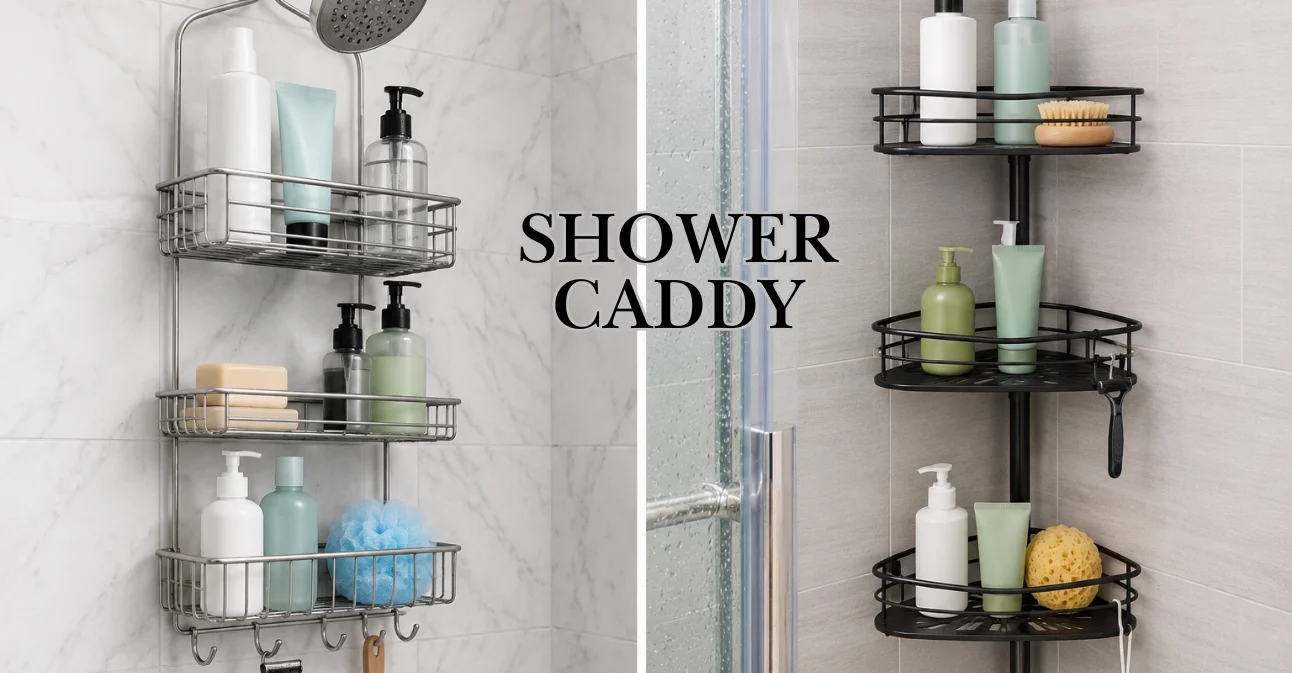
A good shower caddy keeps bottles off the floor, makes toiletries easier to reach, and cuts bathroom clutter. The harder part is choosing a design that fits your shower and stays put. Mounting method, material, available space, and the number of people using the bathroom matter more than appearance alone.
Short answer: The best shower caddy is the one that matches your surface, space, and storage load. For most renters, an over-door or tension-pole model is a sensible choice. Smooth tile or glass suits suction and adhesive shelves. For permanent installations, screw-fixed stainless steel baskets offer the firmest hold and a tidy finish.
Quick comparison: which type suits your bathroom?
| Type | Best for | Main advantage | Main drawback | Typical price level |
|---|---|---|---|---|
| Over-door or hanging | Renters, glass screens | No drilling and easy removal | May not suit sliding doors | Low to mid |
| Suction | Smooth tile or glass | Fast, removable fitting | Poor grip on textured surfaces | Low |
| Adhesive | Fixed no-drill storage | Neat wall-mounted look | Removal can take care | Low to mid |
| Tension pole | Families, shared bathrooms | High storage capacity | Needs enough vertical space | Mid to premium |
| Freestanding corner | Awkward walls, rented homes | No wall attachment | Uses floor space | Low to mid |
| Screw-fixed basket | Permanent bathrooms | Stable and secure | Requires drilling | Mid to premium |
Which type of shower caddy should you choose?
There isn’t one mounting style that works in every bathroom. Your wall finish, shower layout, tenancy status, and storage needs should determine the format.
1. Over-door and hanging designs
An over-the-door organizer is one of the easiest choices for renters. It hooks over a shower screen, door, showerhead, or rail, depending on the design. These models need no adhesive and no holes in your tiles. They can also carry several full-size bottles if the frame is well supported.
Check the hook depth before buying. Thick glass panels and framed doors may need a wider hook. Sliding shower doors can also make this format impractical.
2. Suction-mounted shelves
Suction fittings work best on clean, flat, non-porous surfaces. Glossy tiles and glass are good candidates. Matt, textured, or uneven tiles are much less reliable. The surface should be cleaned and dried before fitting. Keep the suction pad away from grout lines.
Manufacturer weight limits matter because several full shampoo bottles can add up quickly. Guidance for suction-mounted bathroom storage consistently stresses smooth surfaces and careful installation. Suction is useful when you want a removable shelf without committing to adhesive.
3. Adhesive wall shelves
Adhesive organizers give you the fixed appearance of a wall-mounted basket without drilling through tile. They suit smooth walls and can feel firmer than basic suction cups. The trade-off comes when you want to move them. Strong pads may require careful removal, and replacement strips are often required if you change the position.
For rented accommodation, check the manufacturer’s removal instructions before fitting anything that looks permanent.
4. Tension-pole organisers
A tension pole runs vertically between the bath or floor and the ceiling. Several adjustable baskets can be positioned along the pole. This format works well for households with several users. It gives each person more shelf space without putting screws into the wall.
Measure the full vertical distance first. Check where the pole will sit and make sure the top and bottom surfaces are suitable for pressure.
5. Freestanding corner storage
A freestanding unit solves two problems at once: unsuitable walls and a reluctance to mount anything. It can be moved for cleaning and taken with you when you move home. The downside is its footprint. A narrow cubicle can feel smaller once a floor-standing rack is added.
For compact bathrooms, compare its base dimensions with the unused corner space before ordering.
6. Screw-fixed baskets
A properly fitted wall basket is the most permanent option. It can work well in a bathroom you own and plan to keep unchanged. Installation requires more care because drilling through bathroom tiles can crack them or damage hidden services if the location isn’t checked first.
If your bathroom already has a leak or moisture problem, address it before adding fittings. Typify’s guide to dealing with household water damage covers the first steps when water has already affected the property.
Which materials resist rust best?
Bathrooms stay damp for long periods, so material choice affects how long your organizer looks good. Stainless steel is a strong choice because it offers good corrosion resistance. Anodized aluminum is another useful option because it is light and does not rely on decorative chrome plating. Quality plastic avoids metal corrosion completely.
Chrome-plated steel can look smart and cost less, but damage to the finish may expose the metal beneath. Over several years in a damp bathroom, stainless steel holds up better than chrome-plated alternatives. Drainage matters too. Open-wire baskets and perforated plastic shelves allow water to drain rather than collect beneath bottles.
Measure before you buy
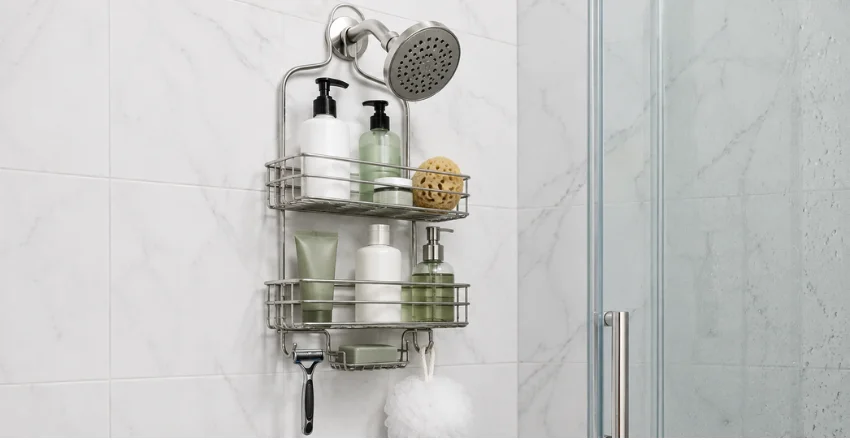
A few measurements can prevent most fit problems. Check these points before placing an order:
- Measure the width, depth, and height of the space where the organizer will sit.
- Check glass thickness or door clearance for hook-over models.
- Measure from the bath ledge or floor to the ceiling for tension poles.
- Note the height of your tallest shampoo, pump, or conditioner bottle.
- Count how many full-size bottles the household normally keeps in the shower.
The same basic rule applies to other household storage products: dimensions and stability matter before extra features. Typify’s ironing board buying guide uses the same size-first approach for choosing home equipment.
How much should you pay in the UK?
Price varies more by mounting system and material than by the number of shelves alone. A current UK retail check shows basic options starting below £10, while premium multi-tier and tension systems can cost more than £100. These examples provide a price reference rather than a product ranking.
| Current example | Listed price when checked |
|---|---|
| Argos Home Steel Hookover organiser | £6.50 |
| Dunelm Wire Suction Caddy | £10 |
| Screwfix Croydex Riser Rail Basket | £14.99 |
| John Lewis Two-Tier Hanging Basket | £30 |
| Simplehuman Corner model at John Lewis | £68 |
| Simplehuman Tension model at John Lewis | £130 |
Prices were checked on 23 August 2026 and can change. Paying more can make sense when the extra cost buys better corrosion-resistant materials, adjustable shelves, stronger fittings, or a longer guarantee. A higher price alone doesn’t prove better performance.
What works best for different bathrooms?
For a rented flat with smooth glass, start with an over-door or high-quality suction design. Both avoid drilling and are easy to remove. For a busy family bathroom, a tension pole or three-tier hanging organizer usually provides more usable capacity. Shared bathrooms benefit from shelves that can separate each person’s products.
For a tiny cubicle, look at a compact corner basket or a narrow wall-mounted shelf. Keeping the floor clear can make the shower feel less crowded. If space is an issue throughout your home, Typify also covers practical small-space ideas in its modular sofa guide. You can browse more household buying and maintenance content in the Home Improvement section.
How to keep bathroom storage clean
Soap residue and standing water can make any bathroom organizer look tired. Rinse the shelves during your normal bathroom cleaning and remove the bottles so you can reach under them. Dry metal fittings when you notice water collecting around joints. Check coated finishes for chips.
If suction pads begin to loosen, remove them, clean both surfaces, and refit them according to the manufacturer’s instructions. Don’t overload a basket because the mounting system, not the shelf size, often determines the safe capacity.
Verdict: the best choice for most people
Our recommendation: choose the mounting style before you compare brands.
An over-door model is the easiest starting point for many renters, as are glass-screen showers. Tension poles make more sense for families that need several tiers. Suction or adhesive baskets are strong choices only when the wall surface is suitable for their mounting system.
For a bathroom you own, a quality stainless steel screw-fixed basket offers a neat, long-term solution when installed correctly. That approach is more reliable than buying the cheapest rack first and trying to make it fit afterwards.
FAQs
Choose a model made from stainless steel, anodized aluminum, or plastic, or select one with a proven corrosion-resistant finish. Keep drainage holes clear and wipe away standing water and soap deposits during routine cleaning.
They can hold well on smooth glass, acrylic surfaces, mirrors, and glossy flat tiles. Textured tiles and grout lines reduce the seal. Clean and dry the surface first, then follow the stated weight limit.
Over-door, hanging, tension-pole, freestanding, and removable suction designs are the easiest options to reverse. Adhesive systems may also work, but you should check how the fixings can be removed before installing them.
One or two shelves are often enough for one person with a simple routine. Couples and families may benefit from three or more levels. Count your usual bottles first, and then allow extra height for tall pumps rather than choosing only by tier count.