A Belfast sink can give a kitchen generous washing space and a distinctive exposed-front look. Yet choosing one involves more than deciding whether you like the traditional style. The cabinet, worktop, taps, waste position, and exact dimensions all need to work together.
| Key point | What to know |
| Traditional material | Fireclay ceramic |
| Distinctive feature | Deep bowl with an exposed apron front |
| Traditional Belfast detail | Open weir overflow |
| Typical use | Kitchens, utility rooms, and boot rooms |
| Installation | Requires firm support and accurate worktop fitting |
| Tap position | Often mounted in the worktop or on the wall. |
| Main advantage | Large, deep washing area |
| Main drawback | Heavy and less forgiving to install than a standard inset basin |
A Belfast sink is a deep, exposed-front kitchen basin traditionally made from fireclay. Its classic distinguishing feature is an open weir overflow. It offers generous washing space and strong visual character, but it needs a suitable base unit, careful worktop templating, and planned tap and waste positions before fitting.
What Is a Belfast Sink?
The traditional design uses a large rectangular ceramic bowl with its front face left visible rather than hidden beneath a worktop. This exposed section is often described as an apron front. Fireclay remains closely associated with the style.
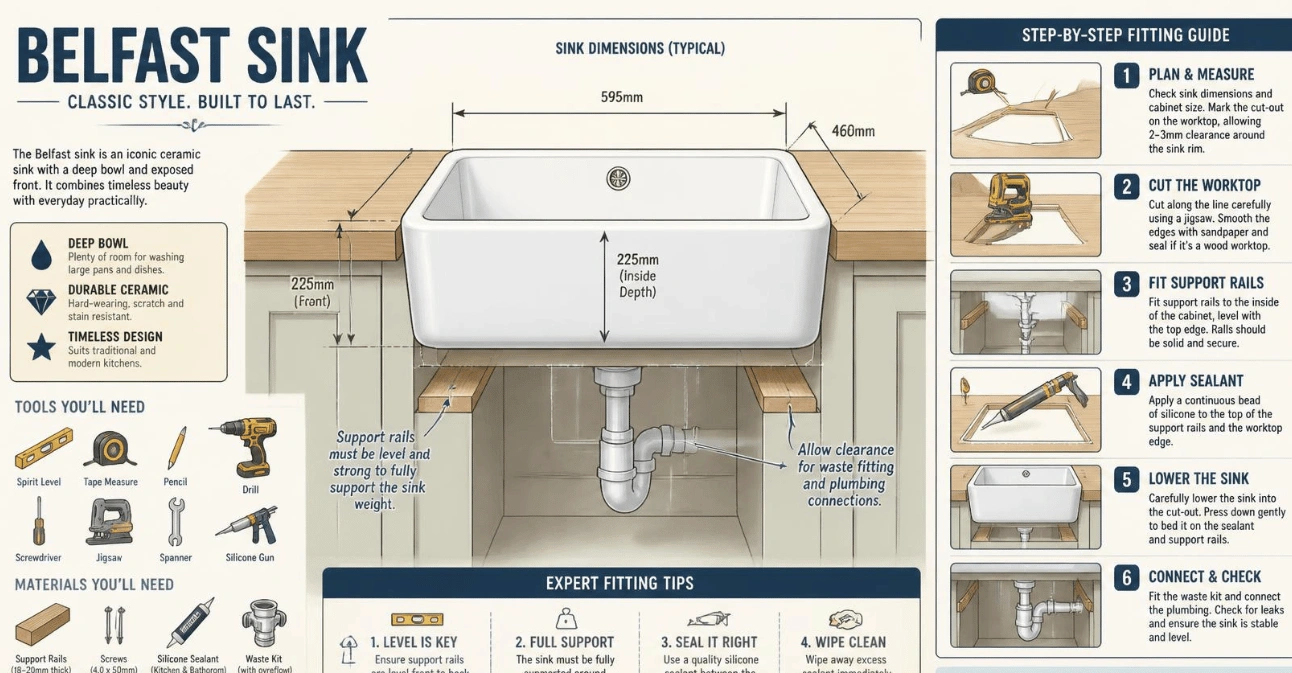
For example, Shaws’ current Belfast model is made from heavy-duty fireclay and includes the characteristic open weir. One 600-class model measures 595 mm wide, 460 mm deep, and 254 mm high. Because it is handmade, Shaws states that dimensions may vary by about 2%.
That variation matters during renovation work. Avoid ordering a worktop from catalogue measurements alone. Your fitter should measure the physical basin before making final cuts. If you’re planning other upgrades around the room, Typify’s Home Improvement section provides related renovation and household guides.
Belfast vs. Butler Sink: What Is the Difference?
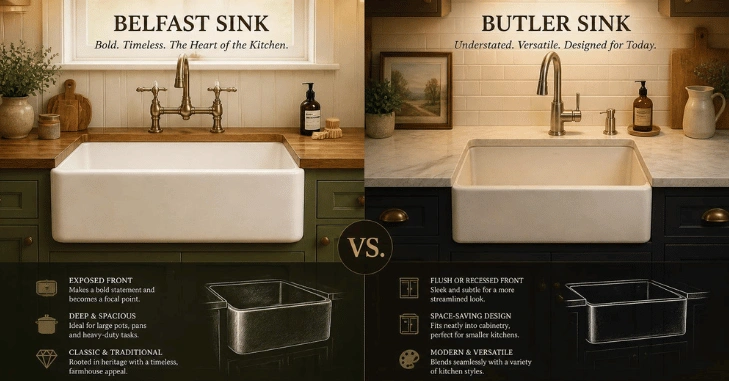
The two names are often used interchangeably. Modern retailers can also label similar products differently. Traditionally, the clearest distinction is the overflow. A Belfast model has an open weir built into the basin. A traditional Butler model does not.
Historic versions also differed in their proportions. The Belfast design tended to be deeper, while Butler sinks were associated with a shallower basin. Current products have blurred these distinctions, so the product specification matters more than the name on the listing.
| Feature | Belfast style | Traditional Butler style |
| Exposed front | Yes. | Yes. |
| Ceramic/fireclay common | Yes. | Yes. |
| Weir overflow | Traditionally yes. | Traditionally no |
| Bowl | Usually deep | Traditionally shallower |
| Modern naming | Often inconsistent | Often used interchangeably |
If an overflow is important to you, inspect the product drawings rather than relying on the title alone.
Pros and Cons for Everyday Kitchens
A Belfast sink works well for households that value bowl space and don’t mind planning the surrounding cabinetry around it.
Advantages
- Large capacity: The deep bowl can accommodate roasting trays, stock pots, and bulky cookware.
- Easy access to the bowl: The exposed front lets you stand close to the basin.
- Strong visual presence: It suits Shaker, farmhouse, and many transitional kitchen designs.
- Hard-wearing material: Quality fireclay is designed to resist common stains and everyday wear.
- Useful beyond kitchens: The deep format can work in utility and boot rooms too.
Drawbacks
- Weight: Fireclay is much heavier than thin stainless-steel construction.
- Cabinet requirements: The bowl needs solid support beneath it.
- More involved fitting: Worktops and cabinet fronts often need accurate adaptation.
- Reduced under-sink space: A deep bowl can take up storage room.
- Impact risk: Fireclay is tough, but a hard blow from heavy cookware can still damage the glazed surface.
If heavy cookware is part of your kitchen setup, Typify’s guide to the best pans for induction hobs covers materials such as stainless steel, cast iron, and carbon steel.
What Size Do You Need?
Don’t choose from width alone. Record the bowl’s width, depth, and height, then compare all three measurements with the available cabinet and worktop space. A commonly sold single-bowl format is around 595-600 mm wide, but larger versions are available. Double-bowl and wide farmhouse designs need substantially more space.
Use this buying sequence:
- Measure the available cabinet run.
- Choose the bowl configuration.
- Check the manufacturer’s external dimensions.
- Confirm the weight and support requirements.
- Check where the waste outlet sits.
- Decide the tap position.
- Obtain the physical product before final worktop templating.
That final step can prevent an expensive cutting error. Fireclay products can have manufacturing tolerances, especially when handmade. Installation guidance from specialist suppliers also recommends using the actual basin as the template before cutting the worktop.
Base Units, Worktops, and Support
This type of basin should not rely solely on the worktop to support its weight. It needs a suitable cabinet or a properly reinforced support structure beneath it. The exact arrangement depends on the sink, cabinet maker, and worktop material. A purpose-designed base often simplifies the job because its front and internal support are already planned around an apron-front bowl.
Worktop fabrication also needs care. Stone, quartz, timber, and laminate all require different detailing around the exposed ceramic edge. For a handmade basin, the safest approach is simple: buy first, then template. Don’t ask a fabricator to make permanent cuts from an online dimension diagram if the manufacturer allows size variation.
Choosing the Tap and Waste
Many traditional apron-front ceramic bowls do not contain a tap hole. The mixer is instead fitted through the worktop behind the basin or mounted on the wall.
Check three details before drilling anything:
- whether there is enough worktop behind the bowl;
- whether the tap spout reaches the center of the usable washing area;
- whether handles can turn freely without hitting the wall or splashback.
The waste deserves the same attention. Deep bowls place the outlet lower than in many conventional sinks so that existing pipework may need adjustment. Don’t assume every waste kit fits every ceramic model. Check the outlet size and overflow connection specified by the manufacturer.
Installation Mistakes Worth Avoiding
The most expensive problems usually happen before the plumbing is connected. Cutting the worktop too early is one example. Small dimensional differences can leave uneven gaps or an opening that cannot be corrected neatly. Another mistake is overlooking the support structure. A heavy ceramic bowl needs a secure base beneath it rather than being treated like a lightweight drop-in fitting.
Tap placement can also cause trouble. If the installer leaves too little space behind the basin, the chosen mixer may not fit or may have restricted handle movement. Finally, avoid over-tightening waste fittings against ceramic. Specialist installation guidance warns that excessive tightening can put stress around the waste opening. For everyday cookware that is easier to handle around a ceramic bowl, you can also read Typify’s non-stick frying pan guide.
How to Clean and Protect Fireclay
Maintenance is usually straightforward. Shaws recommends daily cleaning with a soft sponge or cloth and a non-abrasive cleaner. Soap and water are enough for routine care. Its care guidance also notes that metal cookware or cutlery can leave marks, even though fireclay itself is designed for long service.
A few habits can help:
- Rinse food residue away rather than letting it dry;
- Wipe the basin after use if hard-water spotting is a problem;
- Avoid dropping cast iron or other heavy objects onto the glaze
- Follow the exact cleaner guidance supplied by your sink manufacturer;
- Use a protective grid or mat if your household handles heavy cookware frequently.
Advice about strong chemicals, abrasives, and sudden temperature changes can differ between manufacturers. Follow the care sheet supplied with your own product rather than treating one brand’s instructions as universal.
Is This Style Right for Your Kitchen?
It makes the most sense if you want a deep bowl, an exposed ceramic front, and a kitchen layout that can accommodate purpose-built cabinetry.You may prefer another format if cabinet storage is tight, you want the simplest possible installation, or you regularly need two separate bowls for washing and rinsing.
A stainless-steel inset model is often lighter and easier to fit. A ceramic undermount can retain a clean look without such a prominent apron front. Double-bowl options can make multitasking easier. The right choice comes down to how you use the kitchen rather than style alone.
A Quick Decision Check
Choose this apron-front format if you can answer yes to most of these questions:
- Do you frequently wash large trays and pans?
- Do you like an exposed ceramic front?
- Can your cabinet layout support a heavy bowl?
- Can the worktop be templated around the actual product?
- Are you comfortable giving up some under-sink storage?
- Have you planned where the mixer and waste will go?
If several answers are no, compare alternative sink formats before ordering.
Measure First, Then Finalize the Kitchen
The bowl itself is only one part of the decision. Cabinet strength, exact dimensions, worktop cuts, tap clearance, and waste positioning determine whether the finished installation feels well planned.
Before ordering, record your available width, worktop depth, preferred bowl layout, and tap position. Then compare those measurements against the manufacturer’s technical drawing and give the actual basin to your fitter before permanent worktop cuts are made. That preparation will do more for a successful installation than choosing by appearance alone.
Conclusion
A Belfast sink can be an excellent choice if you want a deep, spacious basin with a distinctive traditional appearance. Its fireclay construction, exposed front, and classic overflow design make it particularly suited to farmhouse, Shaker, and timeless kitchen styles. However, its substantial weight and installation requirements mean it should be treated as part of the kitchen structure rather than simply as another sink to drop into a cabinet.
Before buying, carefully measure the cabinet, worktop, sink dimensions, tap position, and waste outlet. If the sink is handmade, use the actual product for final worktop templating because small dimensional variations can occur. Also make sure the supporting cabinet is strong enough for the finished basin.
Frequently Asked Questions
Traditionally, the Belfast design includes an open-weir overflow, whereas a Butler sink does not. Historic versions also differed in depth and proportions. Modern retailers often use the names loosely, so check the product specification.
Yes, especially if you wash large cookware. The deep bowl provides plenty of working room. The main compromises are weight, installation requirements, under-cabinet space, and the possibility of impact damage to the glaze.
You need a base that can safely support the specific bowl. Purpose-designed apron-front units are common, although a fitter may be able to reinforce or adapt suitable cabinetry.
Not necessarily. What matters is mounting position, reach, and clearance. Many models have no tap hole, so the mixer is fitted into the worktop or wall instead.
Yes. It is a hard-wearing material, but no ceramic surface is immune to strong impacts. Heavy pans should be handled carefully, particularly around exposed edges.
Not always. Shaws, for example, specifies a dimensional tolerance of approximately ±2% for one of its current handmade models. Measure the physical product before final fabrication.
W