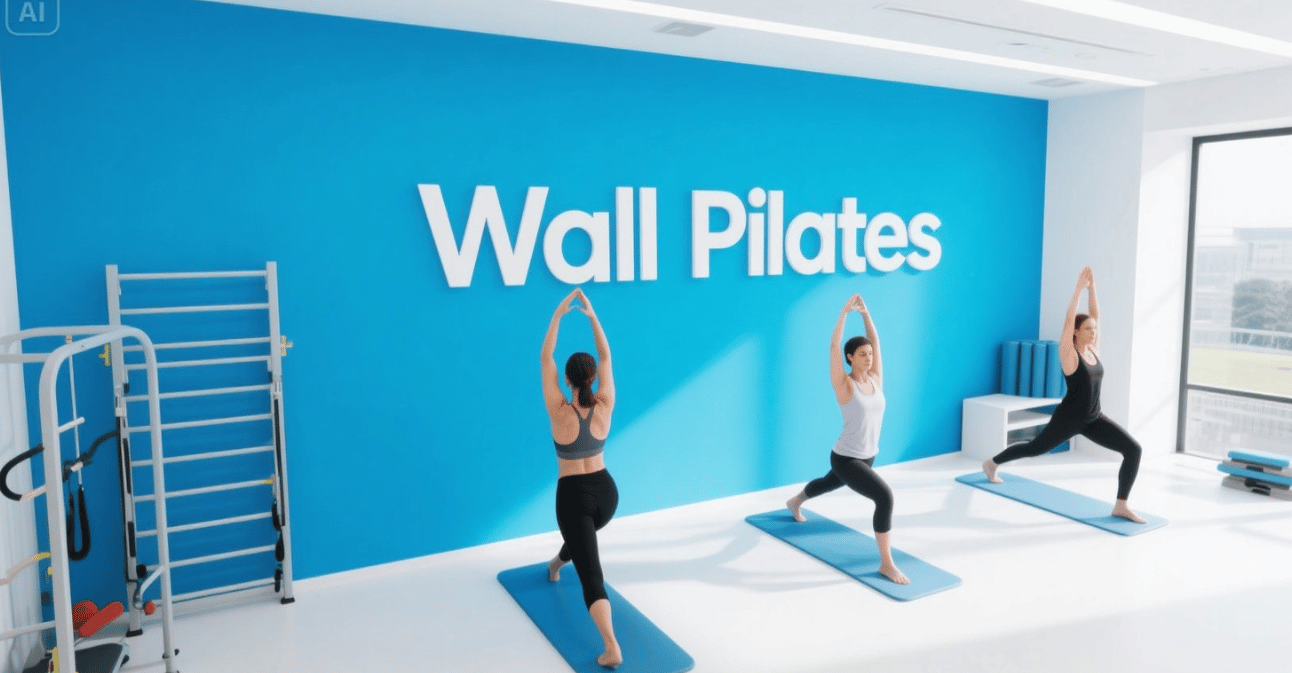
Wall Pilates is a form of Pilates that uses a wall as a prop for support, resistance and posture feedback. You either lie on a mat with your feet on the wall or stand with your back against it, then perform slow, controlled moves such as bridges, roll-downs, leg slides and wall sits. It needs nothing more than a mat, it is low-impact, and it is one of the easiest ways for a beginner to learn good Pilates form at home.
It will not melt fat in 28 days, whatever social media suggests. What it does well is build core and lower-body strength, improve control and mobility, and give you a short, repeatable workout you can fit into a busy week. Below you will find how it works, what it can and cannot do, six beginner exercises with reps and form cues, a 20-minute routine, and the mistakes that most often cause sore knees or backs.
Wall Pilates vs mat and reformer Pilates
If you are deciding which style to try first, this comparison shows where wall Pilates fits.
| Feature | Wall Pilates | Mat Pilates | Reformer Pilates |
|---|---|---|---|
| Equipment | Wall and mat | Mat | Reformer machine with springs |
| Where | Home | Home or class | Studio (usually) |
| Support | High, from the wall | Low | High, from the carriage |
| Resistance | Body weight and pushing into the wall | Body weight | Adjustable springs |
| Cost | Free after a mat | Free after a mat | Studio classes cost more |
| Best for | Beginners, home workouts, posture | Core control, flexibility | Progressive strength with guidance |
In short, wall Pilates sits between mat and reformer work. It gives you more support than a mat alone and borrows some reformer-style leg and footwork, but without the cost of studio sessions. The trade-off is that resistance is limited to your body weight and how hard you press into the wall, so progress eventually depends on harder variations or small props.
How wall Pilates works
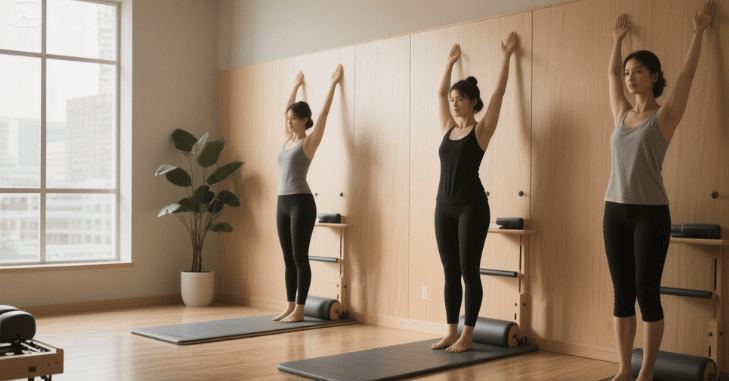
The wall does three separate jobs, and understanding them makes every exercise more effective.
- Support: in standing and balance work, the wall takes some of your weight so you can concentrate on control rather than wobbling. This is why many older adults and people returning to exercise find it less intimidating than mat work.
- Resistance: pressing your feet into the wall in a bridge, or your hands into it in a wall push-up, gives muscles something to push against. The harder you press, the harder they work.
- Alignment feedback: with your back against a flat surface you can feel whether your pelvis is tipped, your shoulders are rounded or your head has drifted forward. On a mat, those errors are much harder to notice.
The wall plays a role similar to the footbar and fixed points on a reformer, which is why so many wall routines include footwork, bridges and leg circles. The classic Pilates principles still apply: move slowly, breathe steadily, and gently draw in the deep abdominal and pelvic floor muscles before each movement rather than bracing hard or holding your breath.
Realistic benefits of wall Pilates
- Core strength and control: bridges, leg slides and planks train the abdominals and the deeper muscles that stabilise the spine and pelvis.
- Lower-body strength: wall sits, bridges and side-lying leg lifts target the glutes, quadriceps and hamstrings, which matter for climbing stairs, getting up from a chair and protecting your knees.
- Posture awareness: regular feedback from the wall helps desk workers notice rounded shoulders and a forward head position.
- Mobility: roll-downs and leg stretches encourage movement through the spine and hips, which often stiffen with long periods of sitting.
- Low impact: there is no jumping, so it is kinder to joints than many high-intensity home workouts.
- Accessible and cheap: a clear wall and a mat are all you need, and a useful session can take as little as 10 to 20 minutes.
Does wall Pilates help with weight loss?
Wall Pilates became famous through dramatic before-and-after videos, but it is essentially a strength and control workout that burns a modest number of calories. It can support weight management alongside regular activity and a sensible diet, and the extra muscle helps with everyday function, but it is unlikely to cause rapid fat loss on its own. The NHS recommends adults aim for at least 150 minutes of moderate activity a week plus strength activities on at least two days, and wall Pilates fits neatly into the strength part. If reducing fat around your waist is the main goal, our guide on how to get rid of love handles covers diet, activity and sleep together.
Who is wall Pilates for?
It suits complete beginners, people returning to exercise after a break, older adults who want gentle strength and balance work, and anyone who would rather train at home than in a gym. It also works as a short recovery or mobility session for runners and gym-goers on lighter days.
Experienced exercisers can make it harder with single-leg variations, longer holds, slower tempos, ankle weights or a loop band. If you are pregnant, recently postnatal, recovering from injury or surgery, or have back, joint or pelvic floor problems, speak to your GP or a physiotherapist first and consider a few sessions with a qualified instructor who can adapt the moves for you.
Six wall Pilates exercises for beginners
Set your mat so its short end touches the wall. For the lying exercises, shuffle your bottom closer or further away until your knees sit at roughly 90 degrees with your feet flat on the wall. Move slowly: a count of three up and three down is a good starting tempo.
1. Wall roll-down
Stand with your back against the wall, feet hip-width apart and about one small step forward. Nod your chin and peel your spine away from the wall one section at a time, letting your arms hang, until you are folded forward as far as is comfortable. Roll back up the same way, feeling each part of your back return to the wall. Aim for 5 slow repetitions. Works: spinal mobility, hamstring flexibility and abdominal control. Form cue: keep your knees soft if your hamstrings are tight.
2. Wall bridge
Lie on your back with your bottom a short distance from the wall and your feet flat on it, knees bent at roughly 90 degrees. Breathe out, press through your feet and lift your hips, keeping your ribs soft and your weight across your shoulder blades rather than your neck. Lower one vertebra at a time. Try 10 to 12 reps. Progression: lift one foot off the wall and hold for a breath. Works: glutes, hamstrings and core.
3. Wall sit
Lean your back against the wall and walk your feet forward, sliding down until your knees are bent, no lower than hip height. Keep knees stacked over ankles and your weight through your heels. Hold for 20 to 30 seconds, adding five seconds each week. Works: quadriceps and glutes. Form cue: if your knees ache, slide higher up the wall.
4. Leg slides
Lie on your back with your legs straight up the wall. Keeping your lower back steady and your pelvis level, slide one leg down and away from the wall only as far as you can control it, then bring it back. Alternate for 8 to 10 per side. Works: deep core stability and hip mobility. Form cue: place a hand under your lower back; if the pressure changes, shorten the range.
5. Wall push-up and plank
Place your hands on the wall at shoulder height, walk your feet back and hold a straight line from head to heels. Hold for 20 to 30 seconds, or bend your elbows to bring your chest towards the wall for 10 push-ups. Works: chest, shoulders, arms and core. Progression: walk your feet further back to increase the load.
6. Side-lying leg lifts
Lie on your side with your back and heels lightly touching the wall. Lift the top leg, letting the heel slide along the wall so your hip cannot roll backwards. Try 10 to 12 per side. Works: outer hips, glutes and pelvic stability. Form cue: lift only as high as you can without your waist crunching.
A simple 20-minute wall Pilates routine
This plan uses the six exercises above. Do it two or three times a week on non-consecutive days for the first month.
| Block | Exercises | Time |
|---|---|---|
| Warm-up | Marching on the spot, shoulder rolls, 5 wall roll-downs | 4 minutes |
| Lower body | Wall bridges, wall sit, side-lying leg lifts | 7 minutes |
| Core | Leg slides, bridge with single-leg hold | 5 minutes |
| Upper body | Wall push-ups, wall plank | 2 minutes |
| Cool-down | Legs up the wall, hamstring and hip stretches | 2 minutes |
How to progress over four weeks
- Week 1: learn the positions. Use the lower end of each rep range and rest whenever form slips.
- Week 2: add two reps to bridges and leg lifts and five seconds to the wall sit.
- Week 3: introduce single-leg bridge holds and slow the tempo to four counts each way.
- Week 4: repeat the main blocks twice for a 25 to 30-minute session, or add a loop band above the knees for bridges and wall sits.
How to get started at home
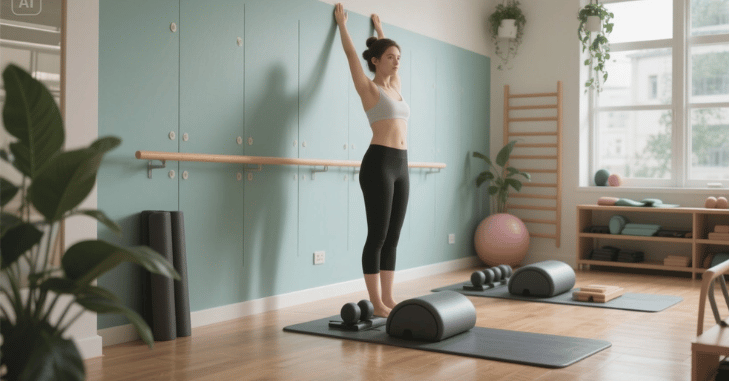
- Find a clear wall: about two metres of solid, free wall with no radiators, shelves or skirting that sticks out too far.
- Use a thick mat: it cushions your spine and stops you sliding. Grip socks help if your feet slip on painted walls.
- Start with two or three sessions a week: 15 to 20 minutes is plenty at first, and rest days help your muscles recover.
- Progress gradually: add reps, longer holds or single-leg versions before buying equipment.
- Track something measurable: how long you can hold a wall sit, or how many controlled bridges you can do, tells you more than the scales.
Once the basics feel comfortable, props such as loop bands, a Pilates ring or a small soft ball add variety and resistance. Our guide to Pilates accessories explains what each one does and which is worth buying first.
Common mistakes to avoid
- Arching the lower back: in bridges and leg slides, keep your ribs down and stop before your back lifts off the mat.
- Holding your breath: breathe out on the effort and in as you return; steady breathing helps the deep core muscles switch on.
- Setting up too close or too far: if your knees drift past your toes in a bridge, or your bottom lifts in leg slides, move your mat and try again.
- Rushing the reps: momentum takes the work away from the muscles you are trying to train. Slower is almost always harder and better.
- Chasing viral challenges: 28-day plans can be motivating, but doing too much too soon often leads to sore knees or a sore back. Consistency beats intensity.
Safety tips

- Warm up first, even for a 10-minute session.
- Keep your neck relaxed in bridges and never roll weight onto it.
- Stop if you feel sharp pain, pins and needles or dizziness. Mild muscle fatigue is normal; pain is not.
- Be cautious with legs-up-the-wall positions if you have high blood pressure or glaucoma, or are in later pregnancy, and check with a health professional first.
- If you have an existing back, hip or pelvic floor condition, a physiotherapist can tell you which moves to modify or skip.
For more home fitness and wellbeing ideas, browse our Lifestyle category.
Frequently Asked Questions
Does wall Pilates actually work?
Yes, for building core and lower-body strength, control and mobility, particularly for beginners. Results come from regular practice over weeks rather than days. It is less effective as a stand-alone weight loss method, so pair it with walking or other activity and a balanced diet.
How often should I do wall Pilates?
Two to four sessions of 15 to 30 minutes a week is a sensible target. When you are starting out, leave a rest day between sessions so your muscles can recover.
Do I need any equipment for wall Pilates?
Only a clear wall and a mat. Grip socks, a loop band, a Pilates ring and a small soft ball are optional extras that add variety once you have learnt the basics.
Is wall Pilates good for beginners?
Yes. The wall gives you support and instant posture feedback, which makes it easier to learn correct form than on a mat alone. Start with the lower rep ranges and progress gradually.
Is wall Pilates better than reformer Pilates?
Neither is better overall. Wall Pilates is free and convenient at home, while reformer Pilates offers adjustable spring resistance and hands-on instructor guidance. Many people use wall work between studio sessions.
Bottom Line on Wall Pilates
Wall Pilates is a practical, low-cost way to build core and leg strength, improve posture awareness and move more freely, all from your living room. Start with the six exercises above two or three times a week, focus on slow controlled reps, and progress one small step at a time. If you have a health condition, are pregnant or are recovering from injury, get advice from your GP or a physiotherapist before you begin.
This article is general information, not medical advice.